

VAT can affect a business’s pricing, bookkeeping, cash flow and relationship with HM Revenue & Customs (HMRC). For a VAT-registered business, the central calculation is usually the difference between output VAT charged to customers and input VAT paid on eligible business purchases.
This sounds simple, but VAT recovery depends on the type of purchase, how the goods or services are used, the evidence held by the business and the VAT accounting scheme being used. A transaction that is a genuine business cost is not automatically a cost from which VAT can be reclaimed.
This guide explains how input VAT and output VAT work for UK sole traders, limited companies, directors, employers, freelancers and other small and medium-sized businesses. It is general educational information, not personalised tax, accounting or legal advice. The VAT treatment of a particular transaction can depend on the facts, so businesses should check current HMRC guidance or obtain professional advice where necessary.
What are input VAT and output VAT?
Input VAT
Input VAT is VAT charged to a business on goods and services it buys for its business activities. Examples may include VAT on stock, office equipment, professional services, software, premises costs, repairs and business travel.
Input VAT is not automatically recoverable. A VAT-registered business normally claims eligible input VAT through its VAT Return when the purchase is connected with its taxable business activities and the required evidence is available.
Output VAT
Output VAT is VAT a VAT-registered business charges on its taxable sales. The business collects this amount from its customers, but it is generally money held on behalf of HMRC rather than business income.
For example, if a business issues an invoice showing a net sale of £1,000 plus VAT, the £1,000 is normally the sales value and the VAT element is output VAT. The applicable VAT rate and whether VAT should be charged must be checked for the particular supply and the relevant period. Do not assume that every sale is subject to the same treatment.
The basic VAT Return calculation
On a standard VAT accounting basis, a business usually adds up its output VAT for the VAT period and deducts recoverable input VAT. If output VAT is higher, the difference is normally payable to HMRC. If eligible input VAT is higher, the business may be due a repayment, subject to the VAT Return and HMRC rules.
This is a VAT calculation, not a calculation of profit. A repayment or payment can also be affected by corrections, imports, reverse-charge transactions, partial exemption and the accounting scheme used.
Who can recover VAT?
VAT recovery is generally available to a business that is registered for VAT, provided the purchase meets the recovery rules. Registration status matters: a business that is not VAT-registered will usually record VAT-inclusive costs rather than claiming input VAT through a VAT Return, subject to any specific rules that may apply when it registers.
A sole trader and a limited company are separate types of taxpayer, but the basic input VAT principle is similar. A sole trader claims through the VAT records of the business operated by that individual. A limited company claims through the company’s VAT records. A director should not treat company VAT as personal VAT merely because they paid for an item personally.
Purchases must relate to the business
The purchase should be made for the business and used for its taxable business activities. If an item has both business and private use, only the business-related proportion may be recoverable where the rules allow. The calculation should be reasonable, consistent and supported by records.
Employees do not normally submit their own VAT claims to HMRC for ordinary work expenses. Instead, an employer may reimburse an employee and, where the conditions are met, the employer may recover eligible input VAT. The employer should retain suitable evidence, such as an expense claim and a valid VAT invoice where required.
Taxable, exempt and outside-the-scope activities
VAT treatment depends on the activity. Taxable supplies are supplies on which VAT is charged at a standard, reduced or zero rate, as applicable. Exempt supplies are treated differently and do not normally carry VAT for the customer. Some activities may also be outside the scope of UK VAT.
A business making both taxable and exempt supplies may be partly exempt. It may then be unable to recover all input VAT and may need to apply an approved or appropriate partial exemption method. This is one area where a simple percentage based on sales may not give the correct answer.

How VAT recovery works in practice
Step 1: identify the VAT treatment
For each purchase and sale, identify whether VAT applies, which rate applies and whether a special mechanism is involved. Relevant issues can include zero-rated supplies, exempt supplies, reverse charge, imports, supplies received from overseas suppliers and capital items.
Step 2: check the VAT invoice or other evidence
A business normally needs a valid VAT invoice or other acceptable evidence before reclaiming input VAT. The document should relate to the actual business purchase and contain the information required by HMRC for the type and value of transaction. A payment card receipt alone may not contain enough information.
Step 3: record the net amount and VAT separately
Bookkeeping records should normally distinguish the net purchase value from the VAT element. The VAT is not simply an additional business expense when it is recoverable. If VAT is not recoverable, the accounting treatment may be different and the VAT-inclusive amount may form part of the cost.
Step 4: include the figures in the correct VAT period
The VAT Return should include transactions in the appropriate accounting period under the business’s VAT accounting method. Timing can differ between invoice accounting and cash accounting, and special rules can apply to imports, credit notes and corrections.
Step 5: reconcile and submit
Before submission, reconcile the VAT control account in the accounting records to the VAT Return. Check that sales, purchases, credit notes, payments and adjustments agree with the underlying documents. A VAT Return is a formal statement to HMRC, so it should not be treated as an automatic output from software without review.
Worked examples of VAT recovery
Example: ordinary taxable business purchases
A VAT-registered design business buys taxable business supplies for £600 plus VAT. It has a valid VAT invoice and uses the supplies entirely for its taxable design work. The business records the net cost as a business purchase and the VAT element as potentially recoverable input VAT.
During the same VAT period, it makes taxable sales and charges output VAT. The business totals its output VAT, totals eligible input VAT and accounts for the difference on its VAT Return. The VAT charged to customers is not treated as turnover for profit purposes merely because it passed through the bank account.
Example: a mixed-use purchase
A sole trader buys a computer for work but also uses it privately. The business should not automatically reclaim all the VAT. It must consider the actual business use and the relevant VAT rules. If only a proportion is recoverable, the records should explain how that proportion was calculated.
Example: an employee expense
An employee pays for a business journey and submits an expense claim to their employer. The employer reimburses the employee. If the expense is allowable for VAT recovery and the employer holds the necessary evidence, the employer may include the eligible input VAT in its VAT records. The employee has not personally reclaimed VAT from HMRC.
Example: VAT is not profit
A limited company receives £1,200 from a customer, consisting of a net sale and VAT. The full bank receipt improves cash flow temporarily, but the VAT element is generally a liability to HMRC. The company’s accounting profit is based on income and expenses under the applicable accounting rules, not simply on cash received and paid.
Expenses where VAT recovery needs particular care
Cars, fuel and motoring
VAT recovery for cars, vans, fuel, mileage and private use can involve specific conditions. A business should not assume that VAT on a vehicle is fully recoverable because the vehicle is registered to the business or used partly for work. The treatment may depend on the type of vehicle, availability for private use, business use and how the cost is charged.
Accommodation, meals and entertainment
Business accommodation and subsistence can have different VAT outcomes from client entertainment or staff events. VAT on business entertainment is commonly restricted, while particular staff-related costs may be treated differently. The purpose, attendees, location and supporting documents can all matter.
Property and premises
Rent, building work, utilities and property transactions require care. A landlord or property owner may have made an election affecting VAT treatment, and construction services can involve special rules. A business should check the invoice and the underlying supply rather than relying only on the description in its bookkeeping software.
Digital services and overseas suppliers
Software, advertising, hosting and other services bought from suppliers outside the UK may involve place-of-supply and reverse-charge rules. Under a reverse charge, the customer may need to account for VAT as if it had made the supply, while also considering whether corresponding input VAT is recoverable. The effect can be neutral for a fully taxable business, but not necessarily for a partly exempt business.
VAT schemes and why the calculation can differ
The standard VAT method is not the only possible method. HMRC provides different VAT accounting schemes, each with its own eligibility conditions and calculation method.
Cash Accounting Scheme
Under cash accounting, eligible businesses generally account for VAT based on payments received and made rather than simply on invoices issued and received. This can help cash flow because VAT on sales is not normally accounted for until the customer pays, but the business must follow the scheme rules and consider how unpaid invoices are treated.
Flat Rate Scheme
Under the Flat Rate Scheme, a business generally calculates its VAT liability using a sector-based percentage applied to relevant turnover, rather than reclaiming all input VAT in the standard way. There are restrictions and special rules, including rules concerning capital assets. The correct percentage depends on the business’s sector and the applicable HMRC guidance, so it should not be guessed.
Annual Accounting Scheme
Annual accounting changes the pattern of payments and VAT Returns for eligible businesses. It does not remove the need for accurate records or make VAT a tax on profit. Businesses should check current eligibility requirements and the effect on cash flow before joining a scheme.
The scheme used should be clearly recorded in the bookkeeping system. A business can produce an apparently plausible VAT figure while using the wrong method, so scheme changes need careful implementation.
Deadlines, rates, thresholds and costs
VAT rates, VAT registration thresholds, scheme eligibility limits and administrative requirements can change. The applicable rate also depends on the goods or services and the relevant effective date. Businesses should never rely on an old spreadsheet, invoice template or online article without checking the current position.
VAT Returns and payments normally follow the business’s assigned VAT accounting periods and HMRC payment arrangements. The exact deadline depends on the VAT Return period, accounting scheme and submission method. Late filing or late payment can lead to consequences under the current penalty and interest regime.
For current registration thresholds, VAT rates, VAT Return deadlines, payment deadlines, scheme rules, penalties and interest, check GOV.UK and HMRC before acting. If a transaction crosses a tax year or a VAT rate change, identify the effective date and apply the rules for that period.
VAT is separate from Income Tax and Corporation Tax. A sole trader’s VAT liability does not itself determine taxable profit or Self Assessment liability. A company’s VAT payment does not itself determine Corporation Tax profit. Cash flow is also different: a business may owe VAT before a customer has paid, unless an applicable cash-based method changes the timing.
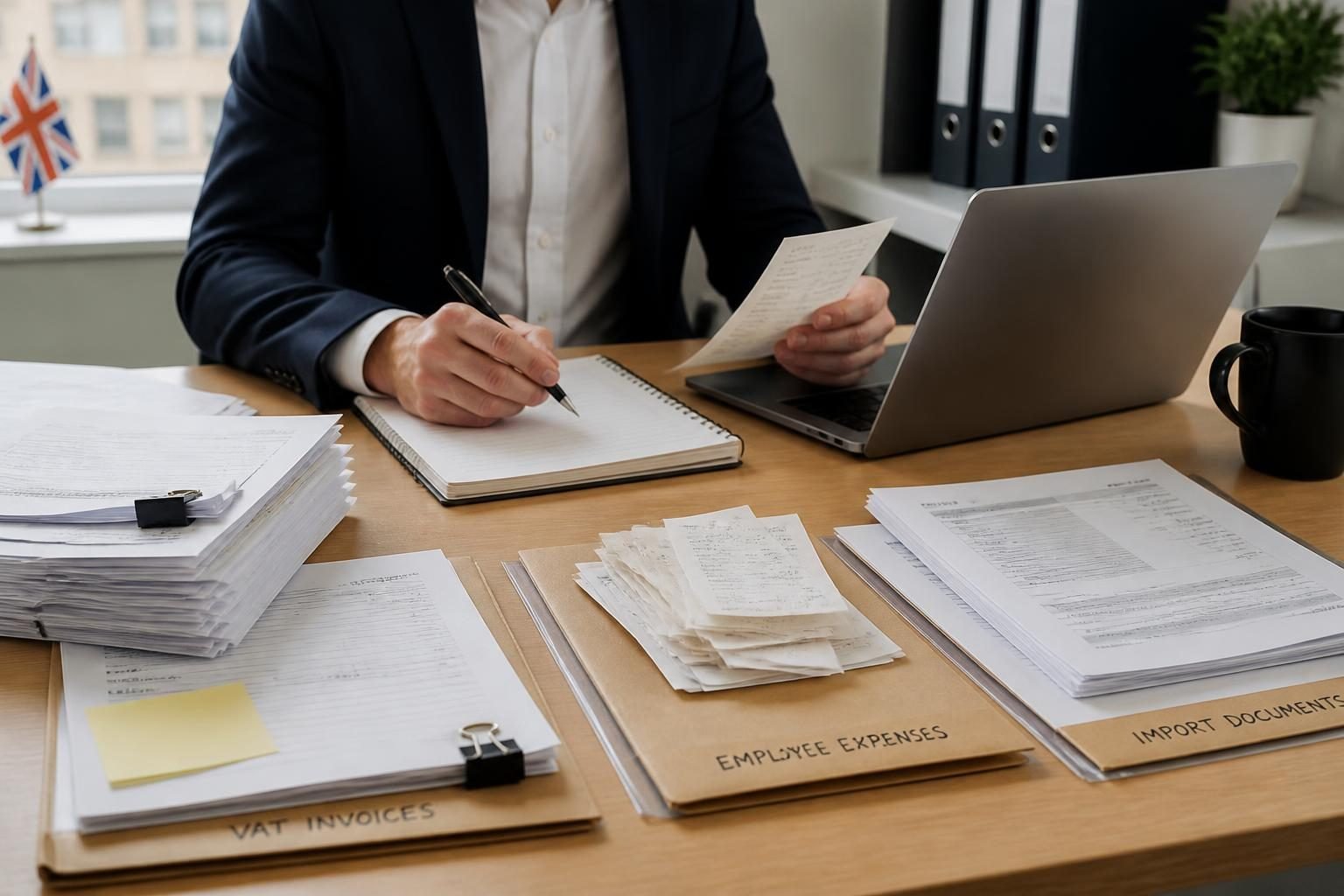
Records and documents to keep
Good VAT recovery depends on an audit trail. Records should be complete enough to show what was bought or sold, when it occurred, how VAT was treated and why the treatment was reasonable.
- Sales invoices and purchase invoices, including VAT invoices where required.
- Credit notes, refunds and evidence of adjustments.
- Bank statements, till records, payment records and cash records.
- Import documentation and evidence of import VAT accounting where relevant.
- Employee expense claims and receipts for reimbursed costs.
- Calculations supporting private-use apportionment or partial exemption.
- Records supporting reverse-charge transactions and overseas services.
- VAT Return workings, reconciliations and records of corrections.
- Evidence of VAT scheme elections, changes and effective dates.
VAT-registered businesses may also have obligations under Making Tax Digital for VAT. The detailed digital record and software requirements should be checked on GOV.UK. Records must be retained for the period required by current HMRC rules; the correct retention period can depend on the circumstances, so businesses should verify it rather than relying on an informal practice.
Common VAT recovery mistakes and risks
- Reclaiming VAT without a valid invoice: a bank payment or order confirmation may not be sufficient evidence.
- Claiming all VAT on mixed-use costs: private use should be considered and supported by a reasonable method.
- Confusing VAT with profit: output VAT is generally not sales income, and recoverable input VAT is generally not an ordinary cost.
- Using the wrong VAT rate: the treatment can depend on the exact supply, customer and effective date.
- Ignoring exempt activities: partial exemption can restrict recovery even where costs are incurred by a VAT-registered business.
- Claiming employee expenses personally: the employer normally handles the business VAT treatment after reimbursement and evidence checks.
- Forgetting reverse charge or imports: overseas transactions may need special entries on the VAT Return.
- Failing to record credit notes: corrections to sales or purchases may change output or input VAT.
- Relying entirely on software: software cannot determine the correct tax treatment where the underlying facts are wrong or incomplete.
- Missing a registration obligation: businesses should monitor taxable turnover and check the current HMRC rules rather than waiting until a customer raises the issue.
Where an error is discovered, do not simply alter an old return without checking the current HMRC correction procedure. The appropriate action can depend on the size and nature of the error and the relevant VAT period.
Practical VAT controls for a small business
Businesses can reduce errors by separating VAT tasks from general bookkeeping review. Use dedicated VAT codes for common purchases, require invoices for employee expenses, and review unusual transactions manually. Reconcile the VAT control account before every submission and compare VAT charged with sales reports.
Directors and sole traders should also keep business and private spending clearly separated. If a director pays a company expense personally, the company should record the expense and amount owed to the director correctly; the payment method does not by itself decide whether input VAT is recoverable.
Train staff who raise purchase orders or approve expenses. They should know that a supplier’s VAT registration, an invoice’s wording and the actual use of the purchase all matter. A monthly review of large, unusual or overseas transactions can identify issues before the VAT Return is filed.
Infyvy can use this kind of structured VAT knowledge as part of a business information resource, but a business should still confirm transaction-specific treatment with HMRC guidance or a suitably qualified accountant when the consequences are significant.
Official sources and keeping information up to date
GOV.UK and HMRC are the primary official sources for UK VAT registration, VAT rates, input VAT recovery, output VAT, VAT Returns, payment deadlines, Making Tax Digital, VAT schemes, imports, reverse charge, penalties and record-keeping requirements. Check the current HMRC guidance for the relevant tax year, VAT period and effective date.
For company records, incorporation matters and company filing obligations, check Companies House and the relevant GOV.UK guidance. These matters are separate from VAT but may affect how a limited company maintains its records and responsibilities.
For workplace pension duties, The Pensions Regulator is the relevant official source. For employment rights and statutory employment matters connected with employee expenses or workplace arrangements, consult GOV.UK and ACAS as appropriate.
Tax rules, rates, thresholds, deadlines and administrative procedures can change. Before registering, submitting a VAT Return, correcting an error or entering into a significant transaction, verify the current position with HMRC or obtain advice from a qualified professional. General guidance cannot take account of every business’s legal structure, supplies, contracts, accounting method or private use.