

A VAT invoice is a document issued by a VAT-registered business that records a taxable sale and the VAT charged on it. It allows the customer to understand what was supplied, how much VAT is included and, where eligible, support a claim to recover input VAT (VAT paid on business purchases).
Correct invoicing matters for sole traders, freelancers, limited companies and other organisations. An invoice that is incomplete or shows VAT incorrectly can create problems for the supplier, the customer and the business’s VAT records. The customer may be unable to recover the VAT, while the supplier may need to correct its VAT return or explain the position to HM Revenue & Customs (HMRC).
This guide explains the main UK requirements in practical terms. It is general educational information, not personalised tax, accounting or legal advice. VAT treatment can depend on the type of supply, the customer, the place of supply and the business’s circumstances.
Who needs to issue a VAT invoice?
A business that is registered for UK VAT generally needs to issue a VAT invoice when it makes a taxable supply to another VAT-registered business or to certain other customers. A taxable supply is a sale of goods or services that is subject to VAT, including supplies charged at a zero rate. Zero-rated supplies have VAT charged at 0%, but they are still taxable supplies for VAT purposes.
A business that is not VAT registered must not normally charge UK VAT or describe an amount as VAT on its invoices. This applies whether the business is a sole trader, partnership or limited company. Adding VAT to an invoice without the appropriate VAT registration can lead to an amount being due to HMRC and may need to be corrected.
VAT registration is separate from incorporation at Companies House, Self Assessment registration and PAYE registration. A limited company does not automatically become VAT registered when it is incorporated, and a sole trader does not become VAT registered merely because they are self-employed.
Sole traders and freelancers
A sole trader is an individual who runs a business personally. If the sole trader is VAT registered, their invoices need to meet the relevant VAT invoice requirements. If they are not VAT registered, they should issue ordinary business invoices without a VAT amount.
Being VAT registered does not mean that VAT is the same as profit. VAT collected from customers is generally money held for accounting to HMRC, while allowable business expenses and input VAT affect separate calculations. A sole trader’s accounting profit, taxable profit and VAT position are different records and should not be confused.
Limited companies and directors
A limited company is a separate legal entity from its directors. The company should issue invoices in the company’s name and use its own VAT registration details where applicable. A director’s personal name may appear as a contact, but this does not replace the company’s required legal identity.
Money received by a company, VAT collected by the company and the company’s accounting profit are not automatically the director’s personal income. Directors should keep company and personal transactions separate and use appropriate accounting records.

Information required on a full UK VAT invoice
For most business-to-business supplies, a full VAT invoice should include enough information to identify the supplier, customer, transaction and VAT calculation. HMRC is the primary official source for the detailed rules and exceptions.
- A unique invoice number: Use a sequential or otherwise unique numbering system. Do not reuse invoice numbers or create unexplained gaps. Separate series can be used where there is a clear business reason, such as different branches or trading activities.
- The date of issue: This is the date the invoice is produced.
- The tax point: This is the date on which the VAT supply is treated as taking place. It is often the date goods are supplied or services are completed, but special rules can apply to payments, continuous services and invoices issued before or after the supply.
- The supplier’s identity and address: Include the legal name of the sole trader or company and an address connected with the business. A trading name can be shown as well, but it should not obscure the legal identity.
- The supplier’s VAT registration number: This should be the VAT number of the business making the supply.
- The customer’s name and address: The customer should be identified clearly. For business customers, use the correct legal or trading identity and address.
- A description of the goods or services: The description should be sufficiently detailed to show what was supplied. Descriptions such as “services” or “work done” may be too vague, particularly where the customer needs evidence for its records.
- The quantity or extent of the supply: Where relevant, show units, hours, days, project stages or other useful measures.
- The unit price excluding VAT: Show the price before VAT, excluding any discount that is stated separately.
- Discounts or rebates: Show discounts clearly and explain whether they have been deducted before VAT is calculated.
- The VAT rate applied: State the applicable VAT rate for each line or group of items. Different items on the same invoice may have different VAT treatments.
- The amount payable excluding VAT: Show the net value of the supply.
- The VAT amount: State the VAT charged in sterling where the invoice is in pounds. If another currency is used, additional presentation and conversion rules may apply.
- The total amount including VAT: Make the amount due clear and ensure the totals reconcile.
Some supplies require additional wording. For example, an invoice subject to the domestic reverse charge should normally state that the reverse charge applies and provide the required information rather than simply charging VAT in the usual way. Other special schemes and supplies, such as margin schemes, exempt supplies, zero-rated supplies, exports and supplies to overseas customers, can have different invoice requirements.
Tax point, invoice date and payment date
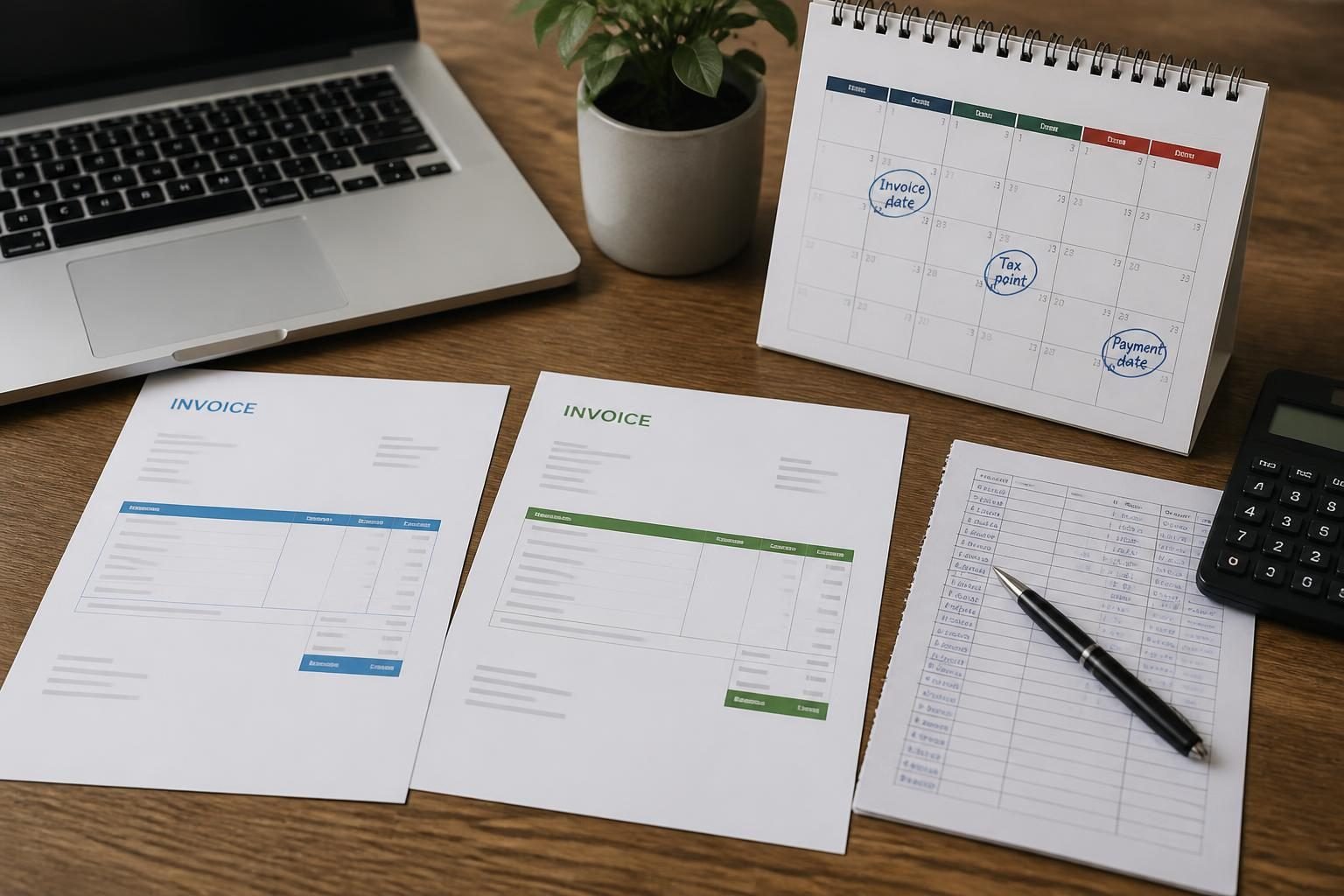
Businesses often treat the invoice date as the date that determines when VAT belongs on a VAT return. That is not always correct. The relevant date is usually the tax point, sometimes called the time of supply. The tax point determines when output VAT (VAT charged on sales) is normally accounted for.
The tax point can differ from the date the invoice is issued and from the date the customer pays. For a straightforward one-off service, the tax point may be linked to completion of the service. A payment received in advance or an invoice issued early can affect the position. Continuous or recurring services may have their own rules.
For this reason, a business should not move invoices between VAT periods simply to match its bank receipts. The correct treatment depends on the applicable VAT accounting method and the facts of the supply. Cash Accounting VAT, where eligible, generally links VAT accounting more closely to payment dates, but it does not remove the need for accurate invoices and records.
Example
A VAT-registered consultant completes work in one VAT period, sends the invoice shortly afterwards and is paid in a later period. Under the normal VAT accounting approach, the business may need to account for output VAT by reference to the tax point rather than waiting for payment. The exact result depends on the supply and the VAT accounting scheme used.
Simplified invoices and special invoice situations
Not every transaction requires a full VAT invoice. HMRC permits simplified or less detailed invoices in certain circumstances, including some lower-value retail transactions. The information required depends on the type of invoice and the value or nature of the supply.
A simplified invoice may show fewer details, but it must still contain the information required for that type of invoice. A business should not assume that every small sale can use a simplified invoice, particularly where the customer needs a full VAT invoice to support its own records.
There are also special rules for:
- supplies covered by the domestic reverse charge;
- supplies to customers outside the UK;
- exports of goods;
- zero-rated and exempt supplies;
- agents acting on behalf of principals;
- credit notes and corrected invoices;
- VAT margin schemes;
- self-billing arrangements; and
- businesses using particular VAT accounting schemes.
An overseas customer does not automatically mean that no UK VAT is due. The place-of-supply rules differ between goods and services and can depend on whether the customer is a business or a consumer. Evidence supporting an export or an overseas customer’s status may also matter.
VAT invoices, VAT returns and business records
A VAT invoice is one part of the VAT records. The supplier should be able to connect sales invoices, purchase invoices, credit notes, payments and VAT return figures. A customer should retain purchase invoices and other evidence supporting input VAT recovery.
Input VAT is not automatically recoverable merely because an invoice includes a VAT amount. The purchase must generally relate to business activities and satisfy the relevant conditions. Some categories of expenditure have special restrictions, and partial exemption can limit recovery where a business makes both taxable and exempt supplies.
Records to keep
Depending on the business and transaction, records may include:
- sales invoices and copies of invoices issued;
- purchase invoices and receipts;
- credit notes and evidence of corrections;
- import and export documents;
- evidence supporting zero-rating or an overseas place of supply;
- VAT account calculations and VAT return workings;
- bank records and payment evidence;
- contracts, orders and delivery or completion evidence; and
- records of adjustments, reverse charges and special schemes.
VAT records generally need to be retained for the period required by HMRC. The standard period is commonly six years, but particular records or circumstances can require a different approach. Keep records in a way that allows figures on a VAT return to be traced back to source documents. Businesses using compatible digital systems should also consider their obligations under Making Tax Digital for VAT and check current GOV.UK guidance.
Important deadlines, rates, thresholds and costs
VAT rates, registration thresholds, invoicing rules and administrative requirements can change. The current standard, reduced and zero rates should be checked on GOV.UK rather than copied from an old invoice template. A rate can also depend on the precise goods or services and whether a special relief applies.
VAT-registered businesses must submit VAT returns and pay any VAT due by the deadlines that apply to their VAT accounting period and filing arrangement. The deadline is not necessarily the same for every business. A business should check its VAT online account, registration information and HMRC guidance.
Businesses should also monitor whether they are approaching the VAT registration or deregistration threshold. These thresholds are subject to change and can involve specific tests, including taxable turnover over a relevant period and expected future turnover. Do not rely on an invoice total or a bank balance alone when assessing registration obligations.
There is no universal government fee for issuing a VAT invoice. Software, bookkeeping and accountant costs vary by provider and circumstances. Late filing, late payment, inaccurate returns and careless records can result in HMRC consequences under the rules in force at the time. Check the current penalty framework on GOV.UK before relying on an older explanation.

Common VAT invoice mistakes and how to avoid them
Charging VAT when the business is not registered
A non-registered business should not add VAT to its invoice. If this happens, the invoice should be reviewed promptly and corrected. The customer should not assume that the amount shown as VAT is recoverable.
Using the wrong VAT rate
Businesses sometimes apply the rate they normally use without checking the exact supply. Mixed invoices are particularly risky. Separate the lines, identify the treatment and retain evidence for unusual or zero-rated items.
Leaving out the VAT registration number
A VAT number is not the same as a company number, Unique Taxpayer Reference or bank account number. Putting a Companies House registration number where the VAT number should be can make the invoice defective.
Using vague descriptions
“Consultancy” may be adequate in some contexts, but a description such as “website accessibility review, 12 hours, completed in June” is more useful. Clear descriptions help the customer, support audit trails and reduce disputes.
Confusing net, VAT and gross totals
The net amount is before VAT, the VAT amount is the tax charged and the gross amount is the total including VAT. A calculation error can affect both the invoice and the VAT return. Check that line totals, discounts and the final VAT calculation agree.
Reusing invoice numbers or altering issued invoices silently
Do not delete or overwrite an issued invoice without a clear audit trail. Use a credit note or replacement invoice where appropriate, link the documents and explain the correction. Retain the original records.
Assuming payment date controls all VAT accounting
Under normal VAT accounting, payment date may not determine the VAT period. Check the tax point and the VAT accounting scheme before moving a sale into a later return.
Ignoring reverse charge rules
Some supplies require the customer to account for VAT rather than the supplier charging it. The supplier must identify when the reverse charge applies and include the required wording and details. This is especially important in sectors where domestic reverse charge rules apply.
Recovering VAT from an inadequate purchase invoice
Keep valid purchase evidence and check that the supplier’s details, VAT number and VAT amount are present where required. A card receipt or bank statement alone may not provide enough evidence for input VAT recovery.
A practical VAT invoice checklist
- Confirm whether the supplier is VAT registered and whether the supply is taxable.
- Identify the customer and establish whether business-to-business or consumer rules apply.
- Determine the tax point and the correct VAT treatment.
- Use a unique invoice number and state the issue date.
- Include the supplier’s legal details, address and VAT registration number.
- Include the customer’s name and address where a full invoice is required.
- Describe the goods or services clearly, with quantities or hours where relevant.
- Show net amounts, discounts, VAT rates, VAT amounts and the gross total.
- Add any required wording for reverse charge, exports, margin schemes or other special treatment.
- Save the invoice and supporting evidence in the accounting records.
- Reconcile issued invoices to the VAT return and investigate unusual differences.
Using an accounting system can reduce arithmetic and numbering errors, but software does not decide every VAT treatment correctly. The person responsible for the business should review templates, product or service tax codes and unusual transactions. Infyvy readers can use this checklist as a starting point when discussing invoice processes with their bookkeeper or accountant.
Official sources and keeping information up to date
For VAT registration, invoice contents, tax points, VAT rates, thresholds, VAT returns, payment deadlines, record keeping, penalties and Making Tax Digital, GOV.UK and HMRC are the primary official sources. Check the relevant HMRC VAT notices and current GOV.UK guidance because rates, thresholds and administrative rules can change.
For company identity, company records and incorporation matters, check Companies House and GOV.UK. Companies House information does not replace HMRC VAT guidance, so a company number should not be treated as a VAT registration number.
Where invoicing connects with employees, payroll or employment arrangements, GOV.UK and ACAS are relevant sources for employment rights and statutory employment guidance. The Pensions Regulator is the relevant official source for workplace pension duties. These matters are separate from VAT, although the same business may need to manage all of them.
If a transaction is unusual, high value, cross-border, partly exempt or subject to a special scheme, obtain advice from a suitably qualified UK tax professional. Always verify the current rule, rate, threshold and deadline before issuing an invoice or submitting a VAT return.